
CHASING THE RAW MOMENT

Updated: Dec 9, 2025
Daido Moriyama taught me that hesitation kills honesty. This is a reflection on learning to shoot with zero apologies.
- - -
Sanjith Kalpat

Prominent street photographer Daido Moriyama’s photo, Entertainer on Stage, Shimizu, shot in 1967, captures the essence of Moriyama’s style. Growing up in the instability and challenges of post-war Japan, Moriyama developed a rather unconventional technique at that time. Coincidentally this unconventional technique crowned him a pioneer of Japanese photography. He emphasized texture and contrast in his black-and-white photos that highlight the difference of traditional values and modern society in his home country.
Moriyama’s piece captures a Japanese singer, leaning towards the microphone with his eyes closed shut. This photo is cleverly composed, with the mic and the singer’s mouth being placed at the lower bottom thirds to the right while his eyes being at the upper thirds of the picture. The artist framed this shot in a way that shows both the singer and his emotions, as well as the microphone. This is all done to provide context for the audience. The overall photo is very moody, as the image is shot in black-and-white with heavy contrast from the almost “white” highlights and dark shadows. In addition, there is lots of saturated grain for an artistic effect. The focus is on the artist’s expression with the rest of the background blurred. As for the exposure, everything is made intentionally. So yes, some areas are dark and bright, but that is what creates contrast. From my perspective, Moriyama’s gritty and contrasty shot, Entertainer on Stage is no different from his other photos in the sense that they all are uniquely composed to create tension. That is exactly what I experienced when I saw this photo for the first time. In addition, I experience a feeling of uneasiness, which is from Moriyama’s utilization of chiaroscuro, or the technique of including dark and mysterious background textures with harsh spotlighting.
It’s a rough, sharp, and edgy reflection of who Daido Moriyama is. That’s what I love most about his work—each shot feels unfiltered, raw, and visceral. He’s never afraid to show himself through the frames he captures, both figuratively and literally.
A mantra he lives by—and one I have come to live by too—is the embrace of the imperfect. Moriyama reiterates that most of his photos are “often out of focus, rough, streaky, warped”. However, he doesn’t think these “blemishes” are a bad thing. In the end, they are part of his style: embellished imperfections.
In the past few months, I have tried to make an effort to capture anything at first glance with no hesitation, having full unwavering belief of my impulse and camera settings, while accepting all of the “imperfections” that could occur. In fact, Moriyama would point and shoot without any viewfinder or LCD screen. All this being said, it is without a doubt that with his technique, with his mindset, there is a high level of presence and awareness that enabled him to stay in the moment—almost always.
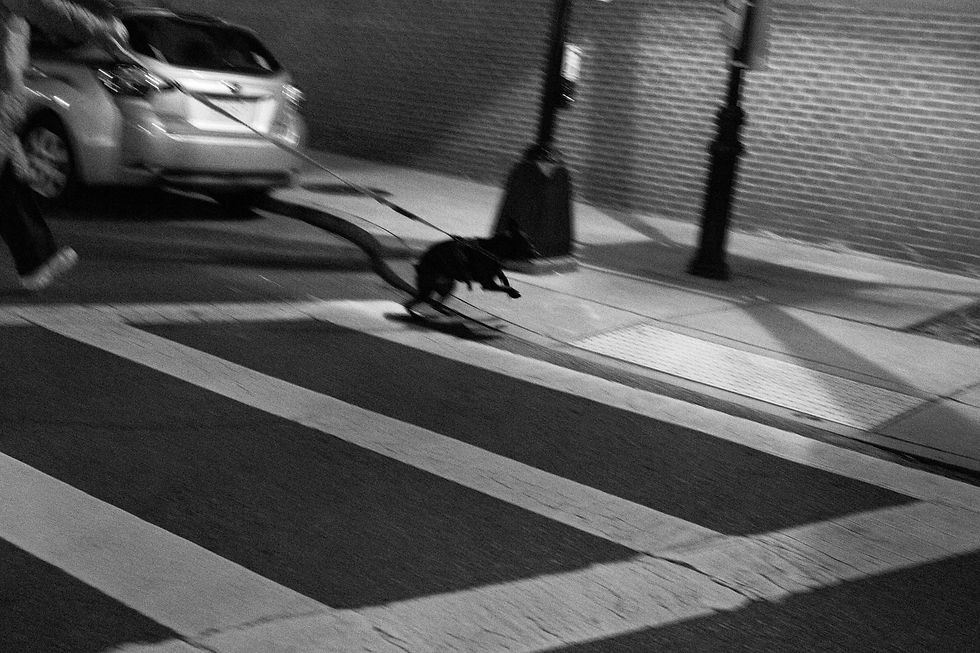
As an aspiring street photographer myself, I have tried to imitate other of his photos like Stray Dog, Misawa. Shot instinctively at night, my take titled, Kuroi Inu (Japanese for “Black Dog”) is less about the subject and more about the feeling evoked from what was seen at hand. At least in my eyes, blur and grain aren’t flaws; it’s the truth of the moment. It's how the night felt.
I believe everyone should aspire to be Moriyama. This seemingly radical and avant-garde approach of photography is something that scraps many beliefs that are adhered to in modern-day practice. It made me realize everything wrong with today’s era of photography, especially the reliance of technology to achieve a very flawed perception of perfection. To put it in Moriyama’s words, “The photographer who attempts to fit happily into the world by using the traditional perspective of the camera will end up falling into the hole of the ‘idea’ he has dug for himself.”
Be RAW. Be VISCERAL. Be IMPULSIVE.


Comments