
THE ART OF COPYING

A reflection on how imitation isn’t the enemy of creativity, but the path that leads toward finding one’s voice.
- - -
Sanjith Kalpat
I believe we can learn something from all artists. Being an endlessly expansive creative domain, it would be safe to assume that the artists are becoming increasingly isolated, each bearing a unique vision that lies within their pieces. While that might be true, the great thing about art is the sheer fact that every work, no matter how personal or distinct, becomes part of a larger conversation. From the brushstrokes that make up the paintings you admire to the lyrics that make up your favorite songs, ideas are borrowed, challenged, or transformed. In the end, art reminds us that—even in solitude—it is a communal act.
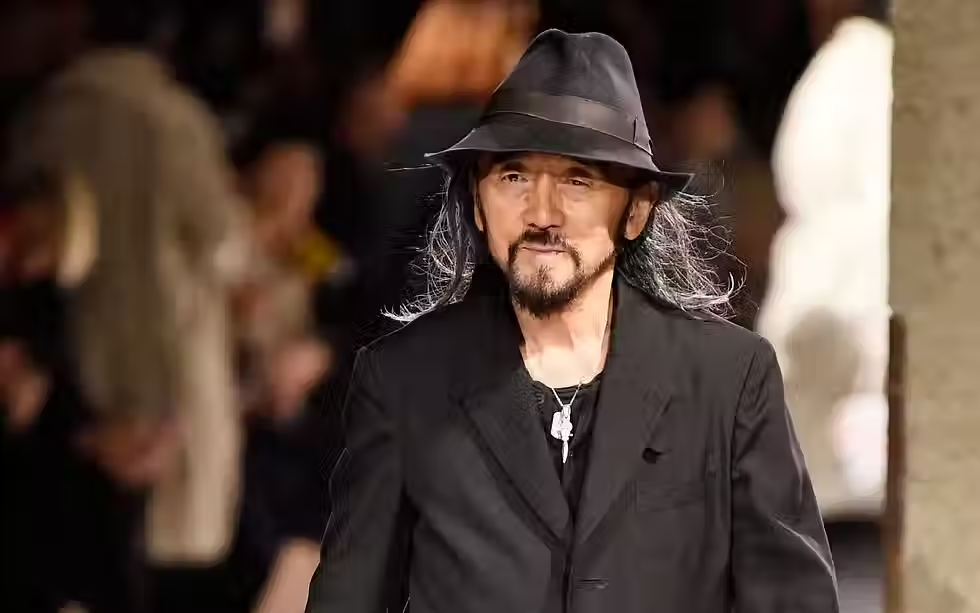
I came to understand this not through theory, but with practice. My own journey in street photography began as a dialogue with others, with creatives who had already shaped the field long before me. As I wrestled with my own voice, I found comfort in Yohji Yamamoto, one of Japan’s highly influential fashion designers, and his words: “Start copying what you love. Copy copy copy copy. At the end of the copy you will find yourself.”
So, what was the first thing I did when I entered the realm of street photography? Copy, copy, copy, copy. My favorite photographers today are those who I once looked upon for inspiration.
Copying the style of greats like Alex Webb, Saul Leiter, Nikos Economopoulos, and Daido Moriyama helped me envision my own style; a style that was implemented and integrated using countless of their techniques and mindsets.
Alex Webb taught me to embrace color and complexity within compositions. At the same time, Saul Leiter taught me to love minimalism and framing. Nikos Economopoulos taught me the importance of emotion and storytelling. Meanwhile, Daido Moriyama taught me to accept “meaningless” work.
These simple ideas collected over time present themselves as fragments of my DNA, not just as a photographer but as my own artist. They were woven together into a style that is not entirely mine, nor entirely theirs, but something that could only exist because of the dialogue between us. Within this very dialogue, I found myself.


Comments